
The Rosary and Pilgrimage: Why Pilgrims Have Carried Beads for Centuries
Affiliate disclosure: This article contains links that may earn Sites of Grace a commission on qualifying purchases, at no extra cost to you. Affiliate Disclosure
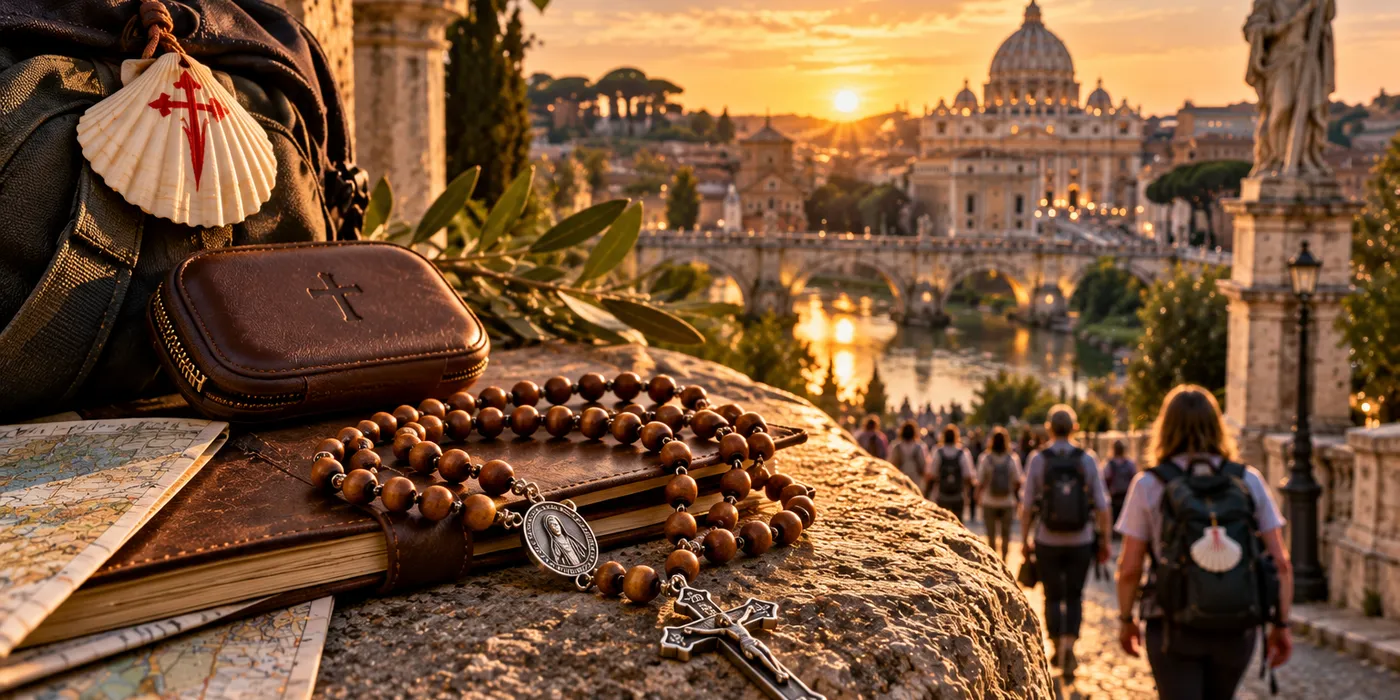
Open the backpack of a Catholic pilgrim and there is a good chance you will find a rosary tucked somewhere inside.
It may be a simple wooden rosary worn smooth from years of prayer. It might be a small cord rosary purchased at a shrine, a rosary that belonged to a parent or grandparent, or one bought specifically for the journey.
Some pilgrims wrap one around their wrist while walking. Others keep it in a pocket. Some carry several because they plan to have them blessed or bring them home to family and friends.
Wherever Catholic pilgrims travel, rosaries seem to travel with them.
There is something fitting about that.
A pilgrimage asks the body to move while the soul searches for God. The Rosary gives that movement a rhythm.
One step.
One prayer.
One bead.
And then another.
For centuries, these simple beads have helped Christians pray when they had no prayer book in front of them, when they were walking unfamiliar roads, when they were afraid, when they were grateful, and when they simply did not know what else to say. The Rosary may be one of the most natural prayers a pilgrim can carry.
A Prayer Made for the Road
A rosary requires very little.
There is no screen to charge.
No book has to remain open.
There is no need for a quiet room.
The prayers can be whispered while walking up a hill, sitting on a train, waiting for a flight, standing in line outside a shrine, or kneeling quietly inside a church. The beads themselves help the pilgrim keep track. That simplicity is part of their purpose.
Pope St. John Paul II wrote that the beads are more than a device for counting prayers. Their movement can symbolize the continuing path of Christian contemplation, while the rosary itself leads toward the crucifix and therefore toward Christ. That imagery feels especially appropriate on pilgrimage. A pilgrim is already following a path. The Rosary gives the heart one to follow as well.
Where Did the Rosary Come From?
The history of the Rosary developed gradually. Christians did not suddenly begin praying the Rosary in exactly the form we recognize today. For centuries, monks prayed the 150 Psalms as part of their regular prayer. Many ordinary Christians could not read or did not have access to books, so repeated prayers such as the Our Father and later the Hail Mary became a way to participate in a similar rhythm of prayer. Knotted cords and beads helped people keep count.
Over time, groups of Hail Marys were connected with meditation on events in the lives of Jesus and Mary. By the later Middle Ages, the devotion had taken a form much closer to the Rosary familiar to Catholics today.
Catholic tradition has long connected the Rosary closely with St. Dominic and the Dominican Order. The Dominicans certainly became some of its greatest promoters, particularly through preaching and Rosary confraternities.
But the history is more gradual than the popular story that Mary simply handed St. Dominic the complete modern Rosary in a single moment. The prayer grew organically within Catholic life. Perhaps that makes its history even more interesting.
Generation after generation added its prayers to the same rhythm until the Rosary became one of the most recognizable Catholic devotions in the world.
The Rosary Is Really About Jesus
Because the Hail Mary is repeated so often, people unfamiliar with Catholicism sometimes assume that the Rosary is primarily about Mary.
That misses what Catholics are actually meditating upon.
The mysteries of the Rosary walk through the life of Christ.
The Annunciation.
The Nativity.
The Baptism of Jesus.
The Last Supper.
The Agony in the Garden.
The Crucifixion.
The Resurrection.
The Ascension.
Again and again, the pilgrim returns to the events of the Gospel.
St. John Paul II called the Rosary a prayer that is Marian in character but Christ-centered at its heart. He described it as a way of contemplating Christ with Mary.
That makes it particularly meaningful at pilgrimage sites. Imagine praying the Joyful Mysteries in Bethlehem. The Sorrowful Mysteries while walking the Via Dolorosa in Jerusalem. The Glorious Mysteries near the empty tomb. The Rosary of Our Lady while standing at Lourdes or Fatima. The words themselves do not change. The place changes the way we hear them.
When Scripture Suddenly Has a Location
One of the most powerful parts of pilgrimage is realizing that the places mentioned in Scripture are real places. Nazareth is not simply a name printed in a Bible, neither is Bethlehem. Jerusalem has streets. The Mount of Olives has a slope. The Sea of Galilee has a shoreline.
When pilgrims pray the Rosary in those places, mysteries they may have prayed hundreds of times can suddenly become physical.
Consider the first Joyful Mystery, the Annunciation.
A pilgrim standing in Nazareth can reflect on Mary's "yes" while visiting the place Christians have associated with that moment for centuries.
Or consider the fifth Sorrowful Mystery.
A pilgrim walking through Jerusalem can hold a rosary while meditating on the Crucifixion only a short distance from Calvary.
The prayer becomes tied to landscape. That is one reason pilgrimage can change familiar prayers. Sometimes we need to leave home to hear familiar words differently.
Why Repetition Matters
The repeated Hail Marys of the Rosary sometimes confuse people who are new to the devotion. Why say the same prayer again and again?
Because repetition creates space.
The words become familiar enough that the mind can move deeper into the mystery being contemplated. Pope St. John Paul II described the repetition of the Hail Mary as a background for contemplation rather than the final destination of the prayer. Pope Benedict XVI similarly described the Rosary as a contemplative and Christ-centered prayer for Christians moving along the pilgrimage of faith. Anyone who has walked a long distance may understand this instinctively.
Walking is repetitive.
Left foot.
Right foot.
Again.
Again.
Eventually the body settles into a rhythm.
The Rosary works in a similar way.
Hail Mary.
Hail Mary.
Hail Mary.
The repetition can quiet the noise enough for something deeper to happen.
A Rosary Becomes Different When You Carry It Somewhere
There is another reason pilgrims carry rosaries.
Objects begin to collect memories. A rosary purchased at Lourdes may always remind someone of praying at the Grotto. A wooden rosary carried up Apparition Hill may still have dust caught inside its beads years later. A rosary from Fatima might bring back the sight of thousands of candles moving through the sanctuary at night. A rosary carried along the Camino might become worn from hundreds of miles in a pilgrim's pocket.
Technically, it is still simply a rosary.
But to the person who carried it, it has become connected to a journey. That is one reason people often bring rosaries home for others. The beads become a small physical connection to the place they visited and the prayers they offered there.
Praying for Someone Else
Pilgrimage is not always about the pilgrim. Often we leave carrying the intentions of other people. A friend battling cancer, a struggling marriage, a child who has stopped practicing the faith, someone hoping to have a baby, a family grieving a death, a person who needs forgiveness, someone who simply asked, "Will you pray for me while you're there?"
A rosary makes those intentions easy to carry.
One decade for one person, Another mystery for someone else. A full Rosary offered for the person who could not make the journey. The traveler may be the one walking the road, but the pilgrimage can carry many people with it. This is one of the beautiful things about Catholic pilgrimage. You rarely travel completely alone.
The Rosary at Lourdes
At Lourdes, prayer and pilgrimage are almost inseparable.
Since the apparitions to St. Bernadette Soubirous in 1858, millions of pilgrims have come to the Grotto of Massabielle. The Sanctuary of Lourdes specifically includes praying the Rosary among the central activities available to pilgrims, along with Mass, the processions, visiting the Grotto, lighting candles, and experiencing the message of Lourdes.
Walk through Lourdes and you will see rosaries everywhere.
In hands.
Around wrists.
Hanging from wheelchairs.
Inside pockets.
Held by pilgrims participating in the evening procession.
The repeated prayer of thousands of people in different languages creates a remarkable sense of unity. The pilgrims may come from different countries. The prayer is still recognizable.
The Rosary at Fatima
It is difficult to separate Fatima from the Rosary.
During the apparitions reported by Lucia dos Santos and Francisco and Jacinta Marto in 1917, the children said Mary repeatedly asked them to pray the Rosary. That request remains central to the spiritual life of Fatima today.
The official Shrine of Fatima describes the Rosary as part of the prayerful rhythm of the sanctuary from its earliest days, with pilgrims meditating on the mysteries of Christ alongside Mary.
One of Fatima's most memorable experiences takes place after sunset. Pilgrims gather around the Chapel of the Apparitions carrying candles and rosaries. The Rosary is prayed. Then the candlelight procession begins. The Shrine made that procession a daily year-round event in 2025 because pilgrim participation in the nightly Rosary had become so consistent throughout the year. Thousands of lights moving through the darkness while the Rosary is prayed is one of those scenes that photographs never quite capture. You have to stand inside it.
The Rosary at Medjugorje
The Rosary is also woven into the daily rhythm of pilgrimage in Medjugorje.
The parish's official prayer schedule includes the Rosary before evening Mass, along with Eucharistic Adoration, confession, the Stations of the Cross, and other prayer. It also schedules the Rosary on Apparition Hill each Sunday. Anyone climbing Apparition Hill will quickly understand why a rosary works so naturally on pilgrimage.
The terrain demands attention.
The climb slows you down.
You stop thinking about how quickly you can reach the top.
A decade passes.
Then another.
Prayer and walking begin to become the same activity. By the time you arrive, the journey itself has become part of the prayer.
A Prayer That Crosses Languages
One of my favorite things about Catholic pilgrimage is hearing the Rosary prayed in different languages.
English.
Spanish.
Italian.
French.
Polish.
Croatian.
Portuguese.
German.
A pilgrim may understand very few of the actual words being spoken and still know exactly where the group is in the prayer.
The rhythm is familiar.
The pause is familiar.
The mystery is familiar.
The response is familiar.
That can be a powerful reminder of something easy to forget when our Catholic experience is mostly limited to our own parish. The Church is enormous. Pilgrimage lets us see it, and the Rosary gives Catholics from different parts of the world a prayer they already share.
The Rosary Does Not Have to Be Perfect
Pilgrims sometimes put unnecessary pressure on themselves. We think prayer must feel profound. We expect silence, focus, emotion, some great spiritual experience. That is not always how pilgrimage works. Sometimes you are exhausted. Sometimes the person walking next to you will not stop talking. Sometimes your knees hurt. Sometimes the church is crowded. Sometimes you are thinking about lunch. Sometimes you reach the end of a decade and realize you barely remember praying it.
Keep going.
The value of the Rosary is not measured by how spiritually impressive we feel while praying it. A pilgrim simply returns to the next bead. And then the next. There is something reassuring about that.
What Kind of Rosary Should You Bring on Pilgrimage?
The best pilgrimage rosary is not necessarily the most expensive one.
It is the one you will actually carry and pray.
For travel, durability matters. Large decorative rosaries can be beautiful at home but inconvenient in a backpack. Fragile chains can snag or break. A simple cord, paracord, wooden, or sturdy metal rosary can often handle travel better.
If you are preparing for a pilgrimage, these are a few useful items to consider.
A Durable Travel Rosary
Look for something comfortable enough to hold and strong enough to survive a backpack.
Amazon search:
Catholic travel rosary durable
Wooden Catholic rosary
A Rosary Case or Pouch
A small zippered or snap case makes a surprisingly useful travel accessory.
Amazon search:
leather rosary pouch
A Pocket Rosary
A one-decade rosary or ring rosary takes almost no room and is useful when walking or traveling light.
Amazon search:
pocket rosary Catholic
Rosary Ring
A Rosary Guide
For someone learning the mysteries or wanting Scripture passages to accompany each decade, a small guide can deepen the prayer.
Amazon search:
Catholic rosary prayer guide
Scriptural rosary book
A Book About the Rosary
Pilgrimage travel includes airports, flights, buses, trains, and quiet evenings. A good book about the Rosary can become part of the journey itself.
Consider looking for writings by St. Louis de Montfort, Pope St. John Paul II, or other trusted Catholic authors on Marian prayer.
Amazon search:
Secret of the Rosary St Louis de Montfort
Rosarium Virginis Mariae book
Catholic books about the Rosary
A Small Prayer Journal
Write down the intentions you were asked to carry.
Names.
Places.
Answered prayers.
Things you noticed.
Things you are still trying to understand.
Years later, those notes may become as meaningful as the photographs you took.
Before You Leave, Ask People for Their Intentions
One tradition worth starting before any pilgrimage is simple.
Ask:
"Is there anything you would like me to pray for?"
Write the answers down. Bring them with you. Then take out your rosary somewhere along the journey. Hold the beads. Remember the people who trusted you with their prayers.
And begin.
One Bead at a Time
Pilgrimage often begins with big expectations.
We imagine the shrine.
The basilica.
The tomb.
The apparition site.
The great moment we have traveled so far to experience.
But many pilgrimages are changed by much smaller moments.
A quiet church.
An unexpected conversation.
A candle lit for someone at home.
A few minutes sitting in silence.
A rosary prayed while walking.
That may be why pilgrims have carried beads for so long.
The Rosary is small enough to fit in your hand, yet it contains the story of Christ's life, death, and Resurrection. It can be prayed by one person walking alone or by thousands carrying candles through a sanctuary. It can travel across an ocean or around the block. And when the road ahead feels long, the Rosary asks very little of us. Do not worry about the whole journey.
Take the next step.
Pray the next bead.
And keep going.