
Reclaiming Halloween: All Hallows’ Eve, All Saints’ Day and Bringing the Saints Back Home
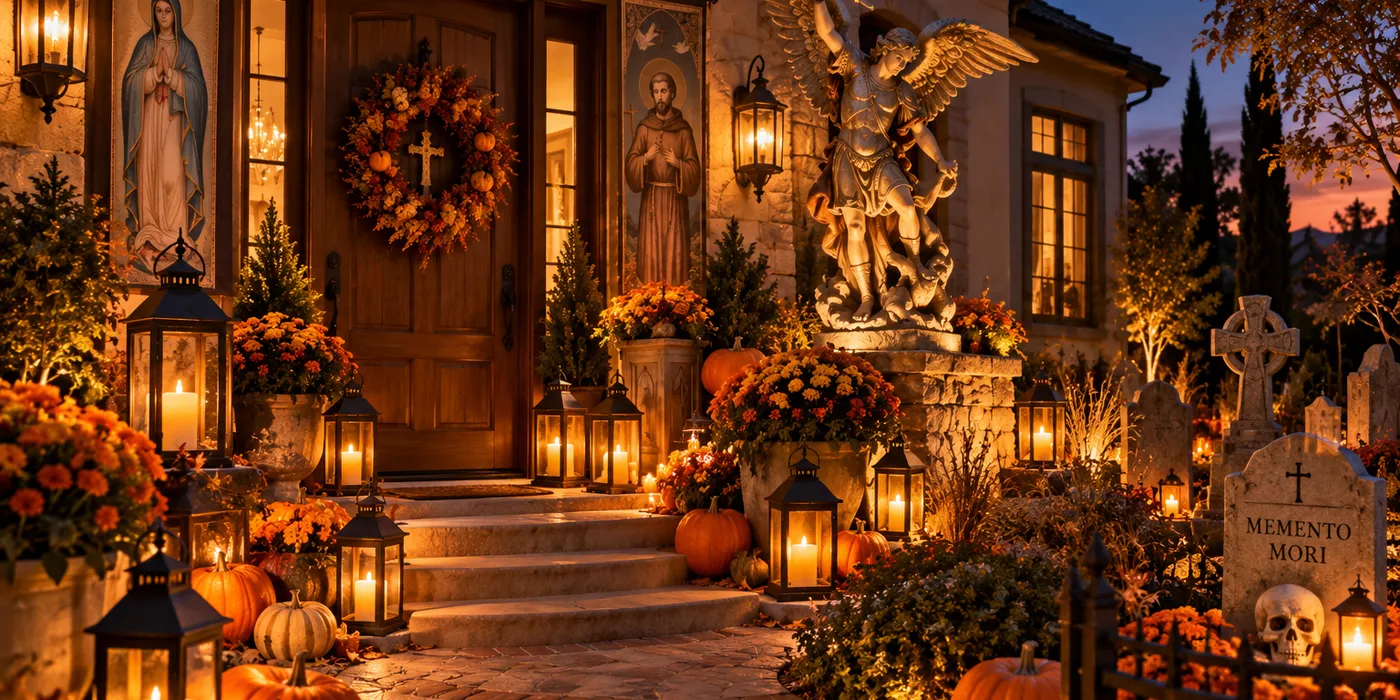
Walk through almost any neighborhood at the end of October and you will see pumpkins, skeletons, ghosts, gravestones, witches, orange lights, and front yards covered in cobwebs.
For most families, Halloween means costumes, candy, parties, and a little harmless fun.
But for Catholics, October 31 can also point toward something much deeper.
The very name Halloween comes from All Hallows’ Eve, the evening before All Saints’ Day. "Hallow" is an old word connected with holiness and the saints. November 1 developed as the Western Church's feast honoring all the saints, and the evening before it became its traditional eve.
That does not mean that every Halloween custom we know today came directly from the Catholic Church. Modern Halloween grew from a mixture of Christian observances, European folk traditions, immigration, and later American popular culture.
But the calendar still gives Catholic families an opportunity.
Instead of simply watching Halloween drift further away from its connection to faith, we can use the season to talk about holiness, death, heaven, the saints, prayer, and the hope of resurrection.
And we can still carve a pumpkin.
Halloween Is Only the Beginning
The end of October and beginning of November form a remarkable progression in Catholic life.
October 31: All Hallows’ Eve
The evening before the Solemnity of All Saints.
November 1: All Saints’ Day
The Church celebrates all the saints in heaven, including the countless holy men and women whose names will never appear on an official calendar.
November 2: All Souls’ Day
The Church prays in a particular way for the faithful departed.
These days move naturally from the reality of death toward the hope of eternal life.
Halloween asks us to confront darkness.
All Saints’ Day reminds us what holiness looks like.
All Souls’ Day reminds us to pray for those who have gone before us.
The Catechism describes the Church as one family that includes Christians still on pilgrimage on earth, those undergoing purification after death, and the saints already in heaven. Catholics call this the Communion of Saints.
Seen that way, this season becomes much more interesting than one night of candy.
All Saints’ Day Is About More Than Famous Saints
When we hear the word "saint," it is easy to think immediately of the people whose statues and stained-glass windows fill our churches.
St. Francis of Assisi.
St. Thérèse of Lisieux.
St. Padre Pio.
St. Carlo Acutis.
St. Joan of Arc.
St. Michael the Archangel.
Those figures deserve our attention. Their lives show us what it can look like to follow Christ in radically different circumstances.
But All Saints’ Day is even bigger.
The Church celebrates the whole communion of saints, including the holy people whose names history never recorded.
Pope Benedict XVI described the saints as an "innumerable crowd," not simply a small group of unusually gifted Christians. Pope Leo XIV likewise spoke of the communion of saints as pointing toward the destiny of humanity united in the love of God.
That makes All Saints’ Day especially meaningful for families.
The saints are not superheroes from another universe.
They were parents, children, priests, soldiers, teachers, doctors, workers, teenagers, widows, kings, servants, missionaries, scholars, and ordinary people.
Some lived into old age.
Others died very young.
Some traveled across continents.
Others spent most of their lives in one small town.
Their personalities were different. Their circumstances were different. Their paths were different.
Their destination was the same.
Bringing the Saints Back Into Halloween
One of the easiest ways to make Halloween feel more Catholic is simply to let the saints become part of the celebration.
You do not necessarily have to replace everything your family already enjoys.
Add to it.
A child can still go trick-or-treating.
There can still be pumpkins on the porch.
The house can still have autumn decorations.
But perhaps St. Michael stands among the pumpkins.
Maybe saint prayer cards are placed around the house.
Maybe the children learn about the saint whose costume they are wearing.
Maybe a lantern glows beside an image of Our Lady.
Maybe the family chooses a new saint to learn about every October.
Halloween does not have to become less fun in order to become more Catholic.
It can simply become more intentional.
Let the Saints Take Over the House
One idea I especially like is creating a temporary Saints Gallery somewhere in the home.
Choose ten or twelve saints.
Print or purchase holy cards or small images and place them along a mantel, shelf, entryway table, or wall.
Try mixing saints from very different times and places:
St. Carlo Acutis
St. Francis of Assisi
St. Joan of Arc
St. Thérèse of Lisieux
St. Padre Pio
St. Catherine Labouré
St. Maximilian Kolbe
St. Joseph
St. Kateri Tekakwitha
St. Augustine
St. Teresa of Calcutta
St. Junípero Serra
Let each child choose one.
Then find out something about that saint that goes beyond the usual one-paragraph biography.
What scared them?
What did they struggle with?
What did they give up?
What did they love?
What made them courageous?
That changes the saints from decorations into people.
Give St. Michael a Place of Honor
If there is one saintly figure who fits naturally into traditional Halloween imagery, it may be St. Michael the Archangel.
Catholic art often portrays Michael in armor, standing victorious over evil.
It is dramatic imagery.
It also communicates something very different from celebrating evil for entertainment.
Michael represents the victory of God over evil.
A statue or image of St. Michael can become the centerpiece of an outdoor Catholic Halloween display.
Surround it with pumpkins, lanterns, fall leaves, candles, or orange flowers.
If you want something more dramatic, add a stone-look pedestal or place the statue among darker autumn decorations so that Michael remains the visual focus.
It can feel completely appropriate for Halloween without confusing what the family actually celebrates.
Skeletons, Skulls and Memento Mori
Catholics do not need to pretend death does not exist.
In fact, Christian tradition has often done the opposite.
The Latin phrase memento mori means, in essence, "remember that you will die."
Skulls appear throughout historic Christian art. Saints including Jerome and Francis have been portrayed contemplating skulls as reminders of mortality.
The purpose is not despair.
It is perspective.
Our lives are temporary. What we do with them matters.
Catholic memento mori imagery points beyond death toward judgment, resurrection, and eternal life.
That gives Catholic families an interesting way to use some traditional Halloween imagery.
A skeleton does not automatically need to represent horror.
A gravestone does not have to be a joke.
They can remind us that life is short.
Imagine a small outdoor cemetery scene accompanied by a wooden sign reading:
Memento Mori
or
Remember Your Last Things
or even the simple words:
Remember Death. Choose Heaven.
That changes the entire meaning of the display.
Candles and Lanterns
Few things fit the season better than candlelight.
They also fit beautifully into Catholic tradition.
Use lanterns along a walkway or around a front porch.
Place battery-operated candles inside brown paper luminaria bags cut with simple Christian symbols:
A cross
A Marian M
A sacred heart
A chalice
A fleur-de-lis
A Chi-Rho
A simple church window
They can be mixed with orange pumpkins and autumn leaves so the house still feels seasonal.
Inside the home, a group of candles around saint images can create a simple All Saints’ display.
For homes with young children, battery-operated candles can provide the same effect without an open flame.
Use the Colors of the Season
Catholic decorating does not need to mean replacing everything with white and gold.
October already provides a beautiful palette:
Orange pumpkins
Deep red leaves
Warm gold candlelight
Dark wood
Black iron lanterns
Cream candles
Greenery
Marigolds
Marigolds are especially beautiful around saint images, candles, crosses, and prayer tables.
Whether using fresh flowers or artificial garlands, they bring the warmth of the season into the home without relying entirely on commercial Halloween imagery.
Mix them with brass candleholders, darker wood, stone, and sacred art and the result can feel both distinctly Catholic and unmistakably autumn.
Build an All Saints Table
Another simple tradition is an All Saints table.
It does not need to be elaborate.
Start with a small table or sideboard.
Add a crucifix.
Then add several saint images or holy cards.
Include candles.
Place flowers or autumn leaves around them.
Add a Bible opened to the Beatitudes in Matthew 5 or Revelation 7, which describes the great multitude standing before the throne of God.
Then let the display change throughout October.
Each week, add another saint.
By November 1, the table is filled with them.
It becomes a visual reminder of something Catholics say every time we profess the Creed:
I believe in the communion of saints.
Remember the Faithful Departed
As All Saints’ Day passes into All Souls’ Day, the focus changes.
The Church has honored the memory of the dead and prayed for them from the earliest centuries of Christianity. The Catechism specifically connects prayer for the dead with the communion of the whole Church.
This is a beautiful opportunity for families.
Place photographs of deceased relatives near your prayer space.
Write their names down.
Visit a cemetery.
Clean a family grave.
Bring flowers.
Pray the Rosary.
Have a Mass offered for someone who has died.
Light a candle.
Tell children stories about grandparents and great-grandparents they may never have met.
All Souls’ Day teaches something that modern culture often avoids.
We do not have to forget people simply because they have died.
We can remember them.
We can pray for them.
And we can live in hope of seeing them again.
So, Can Catholics Celebrate Halloween?
Yes, Catholic families can enjoy Halloween.
There is nothing inherently contrary to the Catholic faith about dressing in costumes, carving pumpkins, handing out candy, or decorating a home.
At the same time, Catholic parents can use prudence about the messages their decorations and celebrations communicate.
There is a difference between acknowledging death and glorifying violence.
There is a difference between spooky fun and making the occult attractive.
There is a difference between a skeleton used as memento mori and treating evil as something worthy of admiration.
Every family will draw those lines a little differently.
The goal does not have to be creating a perfectly sanitized Halloween.
The goal can simply be remembering what comes next.
The saints.
The faithful departed.
The hope of heaven.
A Catholic Halloween Decorating List
If you would like to bring more Catholic symbolism into your home this season, here are some items worth looking for. These are also natural places to include Amazon affiliate links throughout this article.
1. St. Michael the Archangel Statue
A statue of St. Michael makes an excellent centerpiece for a mantle, entryway, porch, or outdoor display.
2. Catholic Saint Holy Cards
Use them to create a Saints Gallery, decorate an All Saints table, or let children choose a saint for the season.
3. Catholic Saint Figurines or Peg Dolls
These work especially well for families with younger children and can become part of an All Saints tradition that comes back every year.
Saint Michael Plush Doll
Catholic saint figurines for kids
4. Battery Operated Votive Candles
Use them around saint images, along windowsills, or inside homemade luminaria.
battery operated votive candles
5. Kraft Paper Luminaria Bags
Add Catholic symbols with simple stencils, then line the walkway or driveway with them.
6. Artificial Marigold Garlands
Mix orange and gold flowers with pumpkins, candles, sacred art, and autumn greenery.
artificial marigold garland orange
7. Black or Antique Brass Lanterns
These bridge traditional Halloween style and Catholic candlelight beautifully.
8. Wooden Crucifix
A larger crucifix can anchor an All Saints table or entryway display.
Catholic wooden wall crucifix
9. Catholic Memento Mori Artwork
Look for traditional Catholic designs involving skulls, hourglasses, saints, crosses, or Latin phrases.
Memento Mori lawn flag
memento mori Catholic art
10. Books About the Saints
Place several on a coffee table or prayer table during October and encourage everyone in the family to choose one saint to learn about.
Catholic book of saints for families
Catholic saints book children
11. Rosaries and Rosary Display Holders
October is also traditionally associated with the Holy Rosary, making it a natural addition to the season.
Catholic rosary wooden beads
rosary holder display
12. Saint Costume Pieces
Instead of purchasing a complete costume, simple pieces can transform ordinary clothing into recognizable saints.
A brown robe can become St. Francis.
Armor can become St. Joan of Arc.
A simple red polo, jeans, backpack, and sneakers can recall St. Carlo Acutis.
A blue mantle can represent many Marian saints and devotions.
medieval monk robe costume
child Joan of Arc costume
kids St. Michael costume
The idea is not to buy twelve new decorations.
Start with a few pieces you can use every year.
Over time, Catholic Halloween and All Saints decorations can become family traditions just like Christmas decorations.
Affiliate Disclosure: Some links in this article may be affiliate links. Sites of Grace may earn a commission from qualifying purchases at no additional cost to you.
As an Amazon Associate I earn from qualifying purchases.
Choose a Saint This Halloween
Maybe the simplest Catholic Halloween tradition does not require buying anything.
Choose a saint.
Learn the saint's story.
Put their image somewhere visible.
Ask for their prayers.
Talk about what made them holy.
Then, when November 1 arrives, go to Mass and remember that All Saints’ Day is not simply about celebrating people who lived long ago.
It is also about what God is calling each of us to become.
Pope Francis once described the saints as belonging to the great family of the Church, while Pope Benedict XVI reminded Catholics that the saints are not a small, unreachable class of people. Holiness is the vocation of every Christian.
That may be the best way to reclaim Halloween.
Not by removing every pumpkin.
Not by getting rid of every skeleton.
Not by pretending the culture around us does not exist.
But by remembering what the evening was pointing toward in the first place.
The saints.
The hope of heaven.
And the invitation to become holy ourselves.