
Eucharistic Miracle of Siena
1730
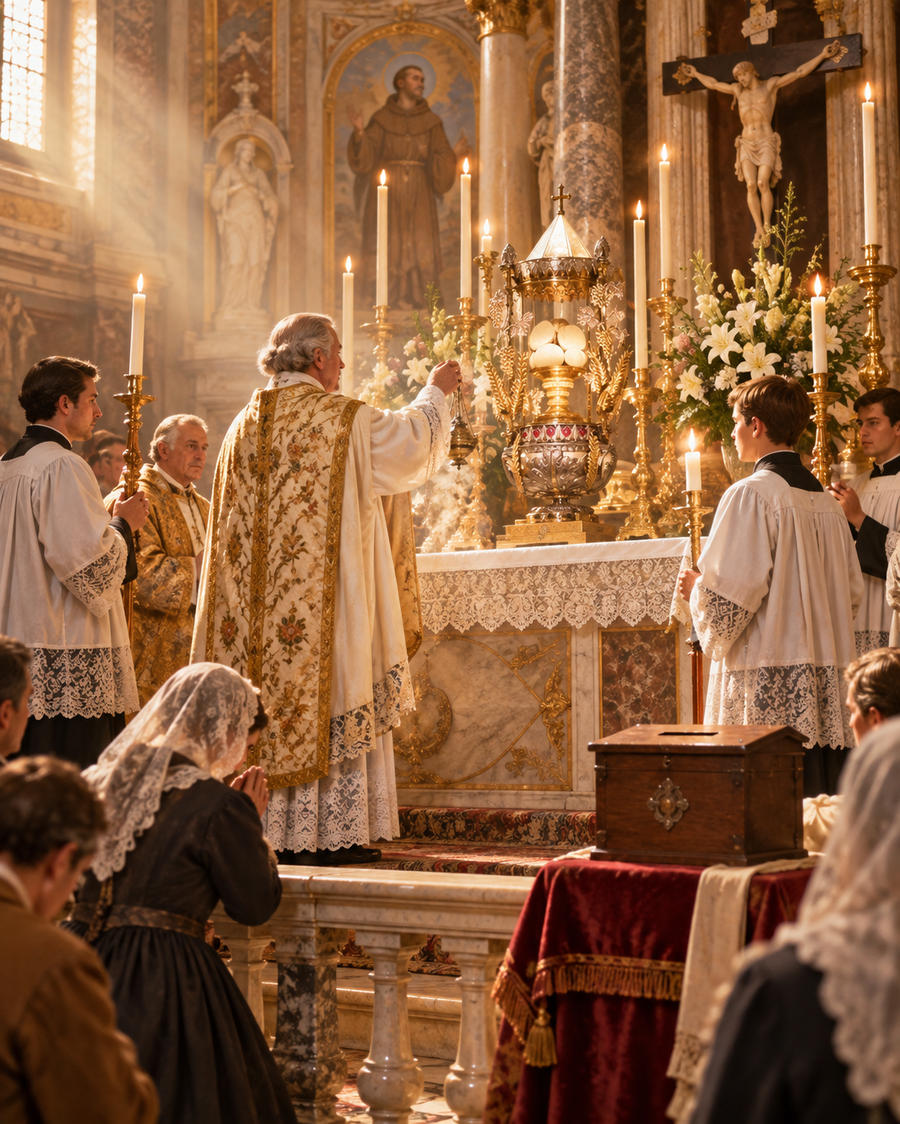
The Eucharistic Miracle of Siena stands as one of the most remarkable and well-documented miracles of Eucharistic preservation in the history of the Church. The miracle of Siena is one of extraordinary incorruption: consecrated Hosts, subjected to rough handling, theft, and exposure, remained perfectly and inexplicably intact for nearly three centuries, defying every law of natural science.
Visit this holy place
How would you like to make this pilgrimage?
Plan your own visit How long to stay, how to get there, what to see, and what to bring. Travel guideWhat happened here
The Story
On August 14, 1730, in Siena, Italy, thieves broke into the Church of St. Francis, picked the lock on the tabernacle, and stole the golden ciborium containing hundreds of consecrated Hosts.
After an intensive search, the sacred Hosts were thankfully found having been stuffed into an offering box in a nearby church, St. Mary of Provenzano. The ciborium had obviously been stolen for its monetary value. The Hosts were immediately returned in procession to St. Francis Church.
Why were the sacred Hosts not consumed at that time? Most likely, they were not consumed because of their soiled condition. After cleaning the Hosts as best they could, those involved probably left the Hosts to deteriorate naturally until they could no longer be called bread.
But the Hosts did not deteriorate. They did not decay. And as the years stretched into decades, and then into centuries, it became undeniable that something far beyond nature was at work.
How to read this account
Church Recognition
Over the years there were multiple investigations, including a thorough examination in 1914 by direction of His Holiness, Pope St. Pius X.
Scientists who examined the Hosts confirmed what the faithful had long believed: the Hosts showed absolutely no signs of deterioration. They appeared fresh — as if consecrated the very day before. This, for any naturally produced unleavened bread, is scientifically impossible across such a span of time.
The Hosts are preserved and venerated at the Basilica of San Francesco in Siena, Italy. The Church has received them back with solemn procession, and they have been the subject of veneration by the faithful ever since. Their preservation stands not as a museum curiosity, but as a living, tangible sign of the Real Presence of Our Lord in the Most Holy Eucharist.
Catholic Teaching
The Miracle of Siena speaks to a profound and often overlooked dimension of Eucharistic faith: the permanence of Christ's presence in the consecrated species. The Catechism teaches that "the Eucharist is the source and summit of the Christian life" (CCC 1324), and that Christ is truly, really, and substantially present under the appearances of bread and wine (CCC 1374).
What the thieves of 1730 did not understand — and what God made unmistakably clear through this miracle — is that the consecrated Host is not mere bread. It cannot be treated as bread. It cannot decay as bread. When God wills it, even the appearance of bread becomes an enduring witness to the living Body of Christ.
A Eucharistic miracle occurs when the accidents of bread and wine change into real human flesh and real human blood — or, as in Siena, when the accidental properties are preserved in ways that transcend all natural explanation.
The miracle of Siena is, in one sense, a quiet miracle — no visible transformation of flesh, no blood. But in another sense, it is perhaps more haunting precisely because of its subtlety. The Hosts simply refused to die. And in refusing to die, they testified — and still testify — to the deathless One who dwells within them.
Go Deeper
The Archdiocese of Siena publishes information on the preserved hosts of the Basilica of San Francesco, and the 'Eucharistic Miracles of the World' exhibition compiled by Blessed Carlo Acutis (miracolieucaristici.org) documents the case and its examinations. See also Catechism of the Catholic Church 1373–1381 on the Real Presence.
Useful before you go
Plan Your Visit
The Pilgrim’s Quick Card
- Ideal stay
- 2 Days The Basilica of San Francesco can be visited in a few hours.
- Best months
- May-Jun Provide comfortable temperatures for walking Siena's hills
- Nearest airport
- Florence Airport (FLR) Approximately 85 km from Siena
- Language & currency
- Italian · Euro (€) English is commonly spoken in Siena
- Accessibility
- Good The Basilica itself is accessible
Plan the trip
How Long Should I Stay?
The Basilica of San Francesco can be visited in a few hours, but Siena itself contains several important Catholic sites. Staying two nights gives you time for Mass, Confession, prayer before the Sacred Hosts, and a visit to the church where they were recovered.
- One day — Basilica of San Francesco, Eucharistic Miracle, Mass and Santa Maria in Provenzano.
- Two nights (recommended) — adds Confession, Eucharistic Adoration, Siena Cathedral and more quiet prayer.
- Three nights — allows a relaxed pilgrimage plus additional Tuscan churches or a nearby pilgrimage destination.
Pilgrim Tip: Siena deserves more than a quick stop. Staying overnight also lets you experience the historic city after most day-trip visitors leave.
Best Time to Visit
Best Overall
May–June and September–October
These months generally provide comfortable temperatures for walking Siena's hills.
August 17
This is the anniversary of the recovery of the Sacred Hosts and one of the most meaningful dates for a Eucharistic pilgrimage.
The Archdiocese traditionally marks the anniversary with special Mass and Eucharistic Adoration.
The 17th of Every Month
The Basilica commemorates the recovery each month with special Eucharistic devotion.
Palio Season
Siena's famous Palio horse races take place around July 2 and August 16.
These are extraordinary cultural events, but the city becomes extremely crowded and accommodations can be expensive.
Interestingly, the original theft occurred on the eve of the Assumption festivities in August 1730, and historical accounts say the Palio celebrations were suspended after the sacrilege was discovered.
For a Quieter Pilgrimage
Choose a weekday in May, late September or October.
Getting There From the United States
Closest: Florence Airport (FLR)
Florence Airport is approximately 85 km from Siena.
The airport's T2 tram connects directly with central Florence and Santa Maria Novella station in about 20 minutes. From Florence, continue to Siena by bus, train, rental car or private transfer.
Best for International Flights: Rome Fiumicino (FCO)
Rome generally offers the broadest selection of nonstop flights from the United States.
From Fiumicino, the Leonardo Express reaches Roma Termini in about 32 minutes, where you can connect toward Florence and Siena.
Alternative: Pisa Airport (PSA)
Pisa can also work well, particularly if your Tuscany itinerary includes Florence, Lucca or the western part of the region.
Typical U.S. Routing
United States → Florence → Siena
or
United States → Rome → Florence/Siena
Our recommendation: If airfare is reasonable, fly into Florence. If Rome offers a substantially easier nonstop itinerary, Rome is a very practical gateway for a larger Italian pilgrimage.
On the ground
Getting Around
You do not need a car once you are staying in central Siena.
The Basilica of San Francesco, Santa Maria in Provenzano, Siena Cathedral and Piazza del Campo are all within the historic center.
Walking is usually the easiest way to explore, but be prepared for:
- Steep streets
- Stairs
- Cobblestones
- Significant elevation changes
Siena's railway station is outside and below the historic center, so a bus or taxi can be helpful when arriving with luggage.
A rental car is useful mainly if you plan to explore the Tuscan countryside or continue to other pilgrimage destinations.
Good to Know: Driving inside Siena's historic center is heavily restricted, so verify parking arrangements before arriving by car.
Where to Stay
For pilgrimage purposes, look for lodging near:
- Basilica of San Francesco
- Piazza del Campo
- Siena Cathedral
- Northern or eastern portions of the historic center
Best For Pilgrims
- Small hotels in the historic center
- Religious guesthouses when available
- Boutique hotels
- Bed-and-breakfasts
- Hotels with elevators for travelers with mobility concerns
Pilgrim Tip: Distance alone can be misleading in Siena. A hotel 10 minutes away may involve a significant uphill walk, so check the terrain before booking.
Accessibility
The Basilica itself is accessible, but Siena's historic center can be challenging.
The Basilica of San Francesco currently lists a platform at the entrance for disabled visitors.
The greater challenge is Siena itself.
Expect:
- Steep hills
- Cobblestones
- Uneven historic streets
- Stairs in some areas
Travelers with significant mobility limitations should consider taxis for longer transfers within the city and select accommodations carefully.
Pilgrim Tip: Siena can still be an excellent pilgrimage for someone with limited mobility, but advance planning is much more important than at Lourdes or Fátima.
What to do
Most Important Things to Do
Venerate the Eucharistic Miracle
The Sacred Hosts are preserved in the Basilica of San Francesco.
On August 14, 1730, thieves entered the church and stole a ciborium containing approximately 351 consecrated Hosts. Three days later they were discovered in an alms box at the nearby Church of Santa Maria in Provenzano, surrounded by dust and cobwebs. The Hosts were returned to San Francesco and preserved rather than consumed. The Archdiocese reports that 223 remain today.
Allow: 30–60 minutes
Best time: During a quieter period between Masses.
Attend Mass at San Francesco
The miracle is best approached through the Eucharist itself rather than simply as an historical phenomenon.
The current visitor listing gives regular Masses at 8:30 AM and 6:00 PM, with additional Sunday Masses. Always confirm before your visit.
Allow: About 1 hour.
Visit Santa Maria in Provenzano
Walk to the church where the stolen Hosts were rediscovered on August 17, 1730.
Visiting both churches makes the story much easier to understand: San Francesco is where the Hosts were stolen and are preserved today; Provenzano is where they were found.
Allow: 30–45 minutes.
Experience the Monthly Eucharistic Devotion
The 17th of each month commemorates the recovery of the Hosts. The Basilica's current visitor information lists additional Masses, exposition of the Eucharistic Miracle and evening Eucharistic Adoration on those days.
If your schedule allows, the 17th is an especially meaningful day to visit.
Visit Siena Cathedral
The magnificent Cathedral of Santa Maria Assunta is one of Italy's great medieval churches and provides additional context for Siena's deep Catholic heritage.
Allow: 1–2 hours.
Spend Time in Eucharistic Adoration
Do not make the pilgrimage entirely about examining the preserved Hosts.
Spend time praying before the Blessed Sacrament and reflecting on Christ's presence in the Eucharist.
Suggested Pilgrimage Itinerary
Day One
- Visit the Basilica of San Francesco
- Pray before the preserved Sacred Hosts
- Attend Mass
- Go to Confession
- Walk to Santa Maria in Provenzano
- Learn the story of the recovery of the Hosts
- Return to San Francesco for quiet prayer or Adoration
Day Two
- Attend morning Mass
- Return to the Eucharistic Miracle
- Visit Siena Cathedral
- Explore the historic Catholic center of Siena
- Spend additional time in prayer before leaving
If you can visit on the 17th: Build the day around the special Eucharistic celebrations at San Francesco.
Mass, Confession & Prayer
The current visitor listing gives:
Daily Mass:
8:30 AM and 6:00 PM
Sunday Mass:
10:00 AM, 11:15 AM and 6:00 PM
The Franciscan friars also provide spiritual assistance and Confession.
On the 17th of Each Month
The Basilica currently lists:
- Additional Masses
- Exposition of the Eucharistic Miracle
- Evening Eucharistic Adoration
The Archdiocese also continues to organize periods of Eucharistic Adoration before the Sacred Hosts.
Important: Mass and Adoration schedules can change. Verify current times shortly before visiting.
Practical
What to Bring
Pilgrimage Essentials
- Rosary
- Small Bible or prayer book
- Written prayer intentions
- Journal and pen
- Small backpack
- Reusable water bottle
Practical Items
- Comfortable walking shoes
- Light rain jacket
- Sunscreen and hat in warmer months
- Layers for spring and fall
- Portable phone charger
- European Type C/F power adapter
- Modest clothing for churches
- Some euros in cash
Pilgrim Tip: Siena is extremely hilly and has many cobblestone streets. Good shoes matter more here than they might appear to on a map.
Before You Go
Approach Siena as a Eucharistic pilgrimage, not simply another stop on a Tuscany vacation.
Before leaving:
- ✓ Check the Basilica's current opening hours
- ✓ Confirm Mass and Confession times
- ✓ See whether your visit falls on the 17th
- ✓ Write down your prayer intentions
- ✓ Pack comfortable walking shoes
- ✓ Plan transportation from Florence or Rome
- ✓ Visit both San Francesco and Santa Maria in Provenzano
- ✓ Spend time in Eucharistic Adoration
- ✓ Attend Mass if possible
- ✓ Leave time for Siena Cathedral
- ✓ Avoid overloading your schedule with sightseeing
Most Important: Understand the complete story. The Hosts were stolen from the Basilica of San Francesco on August 14, 1730, discovered three days later at Santa Maria in Provenzano, and then returned to San Francesco, where the remaining Hosts continue to be venerated today.
Additional Information
What Makes the Siena Miracle Different?
At Lanciano, the tradition concerns the transformation of the Eucharistic species into visible flesh and blood.
At Siena, the reported miracle concerns the extraordinary preservation of consecrated unleavened Hosts dating from 1730.
The Archdiocese reports that scientific examinations in 1914 identified the particles as unleavened bread containing starch and found them in a notably preserved state. Another non-invasive examination in 2014, conducted with authorization from Church authorities, again documented their preservation and absence of microbial contamination.
Where Are the Hosts Kept?
The Sacred Hosts remain at the Basilica of San Francesco and are associated with different chapels within the Basilica depending on the season.
Official Information
Use the Archdiocese of Siena-Colle di Val d'Elsa-Montalcino and official Tuscany tourism resources for current pilgrimage information.
Currency
Italy uses the Euro (€).
Credit cards are widely accepted, although some cash is helpful for cafés, church offerings and smaller businesses.
Local Language
Italian is the primary language. English is commonly spoken in Siena's tourism industry, although it may be less available in smaller religious settings.
Useful phrases:
- Hello / Good morning — Buongiorno
- Thank you — Grazie
- Please — Per favore
- Where is the Basilica of San Francesco? — Dov'è la Basilica di San Francesco?
- What time is Mass? — A che ora è la Messa?
- Where is the Eucharistic Miracle? — Dov'è il Miracolo Eucaristico?
- Do you speak English? — Parla inglese?
Pilgrim travel note: Mass times, opening hours, costs, accessibility, and local conditions can change. Please confirm important details directly with the shrine and your providers before you travel. Travel Disclaimer
Travel with a group
Prefer to travel with a group?
No guided pilgrimages that include Eucharistic Miracle of Siena are listed yet. Many parishes and dioceses organize their own trips, so ask at yours.
Continue your pilgrimage
Sacred places nearby
Information & sources
- Church recognition
- Church-recognized devotion · How the Church judges Eucharistic miracles
Mass times, admission and travel requirements change. Confirm them with the official source before you visit.
Report something that’s wrongFrom pilgrims who have been here
Pilgrim Photos
No pilgrim photos yet — be the first to share one from Eucharistic Miracle of Siena.